Showing posts with label slugs. Show all posts

Sunday, November 13, 2016

Water Greets Land And Brings a Gift

November 14, 2016

As a child I was fascinated by seasonal floods in Amazonia, where rainforest over millions of acres is flooded by many feet of water. Fish swimming among trees in the forest seemed totally bizarre to that child. 

Today I walked the road at Greenhead Slough, where Willapa National Wildlife Refuge, working with local and state partners, recently replaced a tide gate with a bridge, restoring tidal hydrology to several streams and associated floodplains. 

Three Chum salmon in the stream, two to the left, one to the right. All have begun to lose skin, hence the whitish appearance on their sides. 

Tides are very high and low now—a spring tide cycle, which occurs twice each month when the moon is full or new. I saw a near-full moon two days ago. On this full moon cycle, the local floodplains, marshes, and in some cases associated forests, are flooded at each higher high tide every 24 hours. 

Chum salmon came back to their natal streams this season in large numbers. Commercial fishermen caught their quota, and still the salmon kept coming. Last year, refuge stream walkers did not see any chum or coho salmon. This year, chum have returned to all the streams they monitor. Today I saw two streams with chum in them, splashing as they mated and dug out redds to lay eggs. There were dead fish too; I could smell the dead fish as I approached. 

Banana slug and fungi:  which one to eat first?


For the next generation of salmon this is good news:  the bodies of their parents fertilize the streams, tree roots pick up and share nutrients, and animals drag dead salmon off to eat and spread them up slope into the forests. For other salmon species, there is better news:  chum salmon smolt (return to salt water) when they are very small, so they are good food for other salmon species that smolt when larger in size. Seeing many adult chum salmon breeding this fall is a strong indication that other runs of other species will be plentiful four years hence, and their adults will be numerous, large, healthy, and strong. 

Forest underwater:  nutrients, fish, organics surge in with the water across the forest floor.


There was also water among the trees in several areas, taking me back decades in memory to that child, seeing photos of fish swimming among Amazonian trees. Marine anadromous fish not only give us pleasure in fishing for them, livelihood for commercial fishermen, and food for bald eagles, bears, and other animals, they give the forests important nutrients, including calcium, nitrogen, phosphorous, and other minerals. It’s a magnificent sight to see the fish, but the implications that carry forward for future health of both forest and fish runs are also important. When we see a healthy run like this, we see the future of both forest and fish in their presence. 

Rough Skinned Newt walking on a floodplain surface, among deep elk footprints.


The weather was wet, a mild day with light rain, though the wind rose as the hours passed and another storm approached. Rough Skinned Newts and Pacific Banana Slugs were out moving around, well sheltered from the sun by the clouds and rain. Thinking about the movement of nutrients from fish to soil to fungi to trees, I realized that these nutrients reach the slugs too, and any insects that feed on plants or fungi, and also newts. There's a bit of ocean in all of those species in a fish-healthy forest. 

Looking over the highway and across Bear River, salt water floods the marshes and streams from forest edge to forest edge. 


At high tide, there is a large sheet of water from the highway west across Bear River and its associated marshes to the Porter Point peninsula. With dikes gone, with hydrology restored, the winter high tides sweep across the entire landscape, just as they did more than one hundred years ago. Water greets land again, and brings a gift of fish. 

Saturday, September 17, 2016

Autumnal Slug Rain––another kind of rain

September 17, 2016

Friends of Willapa Refuge held a ‘Wonders of Willapa’ event at Tarlatt Unit today. The weather was wet, with steady rain during the morning and longer and longer breaks between rainy periods as the afternoon went on. We stopped by the site around 2 p.m., and walked out to the Tarlatt Slough viewpoint, where you can look north in clear weather to the Olympic Mountains. Not one peak was in sight today, low clouds obscured even the north bay. 

The view north along Tarlatt Slough:  Water and sky merge in the rain.

The highlight of the walk was multiple slug sightings. In some areas, there were slugs every three to five feet. Occasionally, there were three or more slugs within a couple of feet. 

Two Pacific Bananaslugs (lower left and upper center) and a Chocolate Slug (upper right).

I’ve walked in ancient forests in late February, in the rain, and stepped over a frog or salamander with ever step. We call these Salamander Rains, when the coldest temperatures of winter are easing into spring, the soil is thoroughly wet, the air is wet, and amphibians can easily move around from winter hideouts to spring mating streams and ponds. 

In late summer, after months of dry weather, the first soaking rains wet the ground, promote decay of drying vegetation, and voila! The slugs come out of their summer hideouts and frolic in the broad light of day, or so it seemed today. 

Low light, ample food (decaying leaves and fungi for Pacific Bananaslugs, introduced vegetation for Chocolate Slugs), and plenty of atmospheric moisture made this an ideal day for gliding and browsing by slugs, and while the calendar is not quite to Fall, it seems appropriate to name this an Autumnal Slug Rain––not a rain of slugs, but a rain that brings out the slugs. 

A buckskin Pacific Bananaslug, pale yellow and gliding over grasses on the dike.

Pacific Bananaslug, Ariolimax columbianus, is the largest native slug on the coast, commonly seen in forested areas. On the dike these slugs were many yards from the coastal forest, which is their usual habitat. Bananaslugs eat decaying vegetation, mosses and fungi.  The damp day and ample food lured more than one hundred bananaslugs out into the open for the first good noshing they’d had in wet daylight weather for many months. Coloration varied from pale yellow to ochre yellow, some with black spots (small to large), and others plain, or in local lingo, pinto, appaloosa and buckskin slugs. 

Another color form of Pacific Bananaslug, with black spots on an ochre brown body. 

Chocolate Slug, Arion rufus, is one of the larger introduced slugs in the Pacific Northwest. Colors vary from medium brown to very dark brown to black. Today we saw medium brown and very dark brown colorations. This slug is common in gardens, and rarely found in native forest. The dike is largely covered in introduced grasses and flowers, so it too was right at home, feeding in the open on a suitably wet afternoon. As with the bananaslugs, there were more than one hundred Chocolate Slugs in the short walk from the edge of the forest to the overlook area. 


Chocolate Slug, with a medium brown, milk-chocolate-colored body.
I did not see any native or introduced snails today. Shells provide them with some cover during dry seasons, allowing them to move a bit more freely than slugs can. 

Another Chocolate Slug, this one is more of a dark bitter chocolate brown color.


To read more about terrestrial mollusks, see the recent book, Land Snails and Slugs of the Pacific Northwest, by Thomas Burke, with photographs by William Leonard, OSU Press, 2013. There are dozens of native and introduced species in the coastal Pacific Northwest. As for rain terms, at last count, my rain words list has more than one hundred twenty terms. 

Wednesday, October 22, 2014

How far should you toss a snail?

Have you ever wondered where slug and snail eggs are laid? Or how fast and how far slugs and snails can move in a night? How about tossing them out of your garden, if you don’t like killing these invertebrates? Or why, when on morning slug patrol, day after day, there seems to be no lack of these animals in your garden? I think about all of these topics when I'm in my garden.

Slugs and snails are mollusks, one with a shell, one without, that moved to land from water millions of years ago. It’s been a successful shift for them. Mollusks are one of the most prolific and diverse animal phyla on earth; the air-breathing species are both abundant and widespread. These species no longer need to live in water for any stage of their life cycle. In our temperate and humid climate, several species are very much at home in gardens.


Dandelion leaves are smooth, thin and sharply lobed, and grow in low rosettes with one flower per stem. It flowers in spring and again in fall.
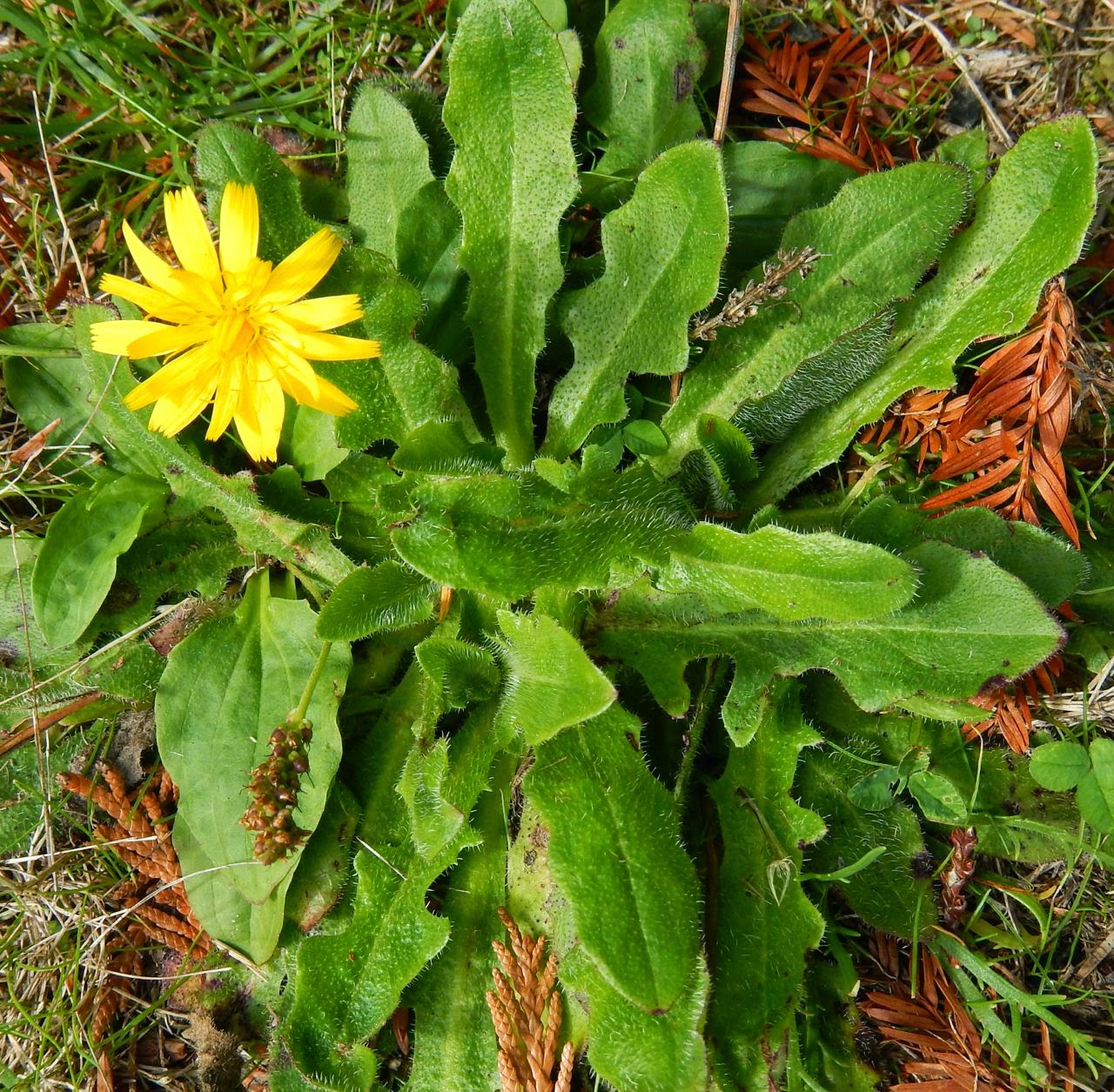
Rosettes of hairy cat's-ear are thick, dotted with hairs and roundly lobed; plants grow in thick rosettes with several flowers per stem. It flowers from summer into fall.
Eggs are laid under plants in the soil to keep them moist. Introduced daisies, including hairy cat’s-ear, Hypochaeris radicata, and dandelion, Taraxacum officinale, are good covers for European slugs and snails. Native slugs and snails prefer damp forest duff layers, and do not lay eggs in gardens. Eggs are soft walled and flexible. They need to stay moist if the tiny creatures are to survive and emerge. Eggs are laid in mid to late spring; young slugs and snails hatch two to four weeks later.

Hatchlings eat their way out their eggs, then the tiny mollusks begin a life of eating and growing. Native slugs and snails eat fungi, decaying wood, and mosses in the woods. Introduced species prefer garden plants and do not normally enter natural woodlands.
Natural pests include many birds, especially when the mollusks are very small. Chickens will eat both eggs and young. Ducks and garter snakes prefer the larger animals. In fact, garter snakes are excellent slug predators. A nice warm compost pile, a few smooth warm rocks to bask on, a source of freshwater in the garden, and you have all the amenities of life that a garter snake prefers, along with fresh slugs and snails for them to eat.


A young slug on a cat's-ear leaf hatched just a few days ago. All of the mollusks that use leaf rosettes in lawns for egg cover and food are introduced species; most are from Europe.

Like deer, European slugs and snails have cosmopolitan tastes––they will browse anything new at least once while deciding if it’s edible or not. One year I planted a native orchid, carefully enclosed it in a ring of slug bait, went back to the house for the durable tag––and when I came back out a few minutes later, a spotted leopard slug and a brown snail were circling the bait ring, enticed by the new plant. The next year, they left it alone.


A leopard slug (lower left) and European brown snail (at top) circle a new plant in their food space, a native stream orchid. These mollusks found the orchid within minutes after it was planted in early spring. The light ring is slug bait, the dark layer beneath is compost. The slug is arching up over the bait to smell the plant; the snail tasted the bait and is withdrawing.

If you aren’t comfortable cutting, crushing or salting these animals, is tossing effective? How far must you toss a snail or slug to keep it from coming back? Several scientists in England who are also gardeners studied this in their own gardens and neighborhoods. 

One man used dots of white paint on snail shells, and tossed them out of his garden, over two fences onto open land, adding a dot every time a previously marked snail showed up. The record holder was a snail that returned 17 times. The average time to return was a month. The next year, he worked with a statistician, numbered the snails and either tossed them (even numbers) or moved them about 70 feet (20 meters) to another garden (odd numbers). Only 3 of 151 odd-numbered snails returned.

Another gardener tested snail homing abilities by painting numbers on her snails, persuading her neighbors to do the same, all using different colors, one color for each garden, then swapped them around in the neighborhood. She found that snails can often find the way back, over a distance of about 32 feet (10 meters).

An ecologist working with her was intrigued by this finding. He attached LEDs to some snails, and painted others with glow-in-the-dark paints. Using time-lapse photography, he found that snails move about 1 meter (3.2 ft) a hour at top speed, and could move up to 10 meters (32 ft) per night. “In wet weather, they form convoys, sliding along the slime trails of preceding snails, which Hodgson suspects helps them save energy.” (New Scientist, 12 July 2014, page 37) To see a time-lapse video of LED-marked snails, go to http://www.thisiscolossal.com/2013/08/timelapse-video-of-hundreds-of-snails-tagged-with-leds-at-night/ 

If snails keep returning, is tossing useful? Yes, because it may help give plants a break in being eaten. They grow stronger with a few days of rest from munching, and when the snails return, plants are better able to cope with the damage. The farther away the snails are taken, the fewer return; 20 meters (70 ft) is good as a tossing/moving distance, but even 5 meters (16 ft) gives plants a few days break.

Both slugs and snails can be seen determinedly gliding somewhere, heading for their preferred foods in my garden when weather is cloudy and moist. This is a good time to practice slug and snail tossing. Just don't toss them into your neighbor's garden!


Think of this patch of hairy cat's-ear as a slug factory, capable of hatching thousands of baby slugs each year. It's also a late summer nectar source for Woodland Skipper and other butterflies. 


Published October 22, 2014 in the Chinook Observer.